
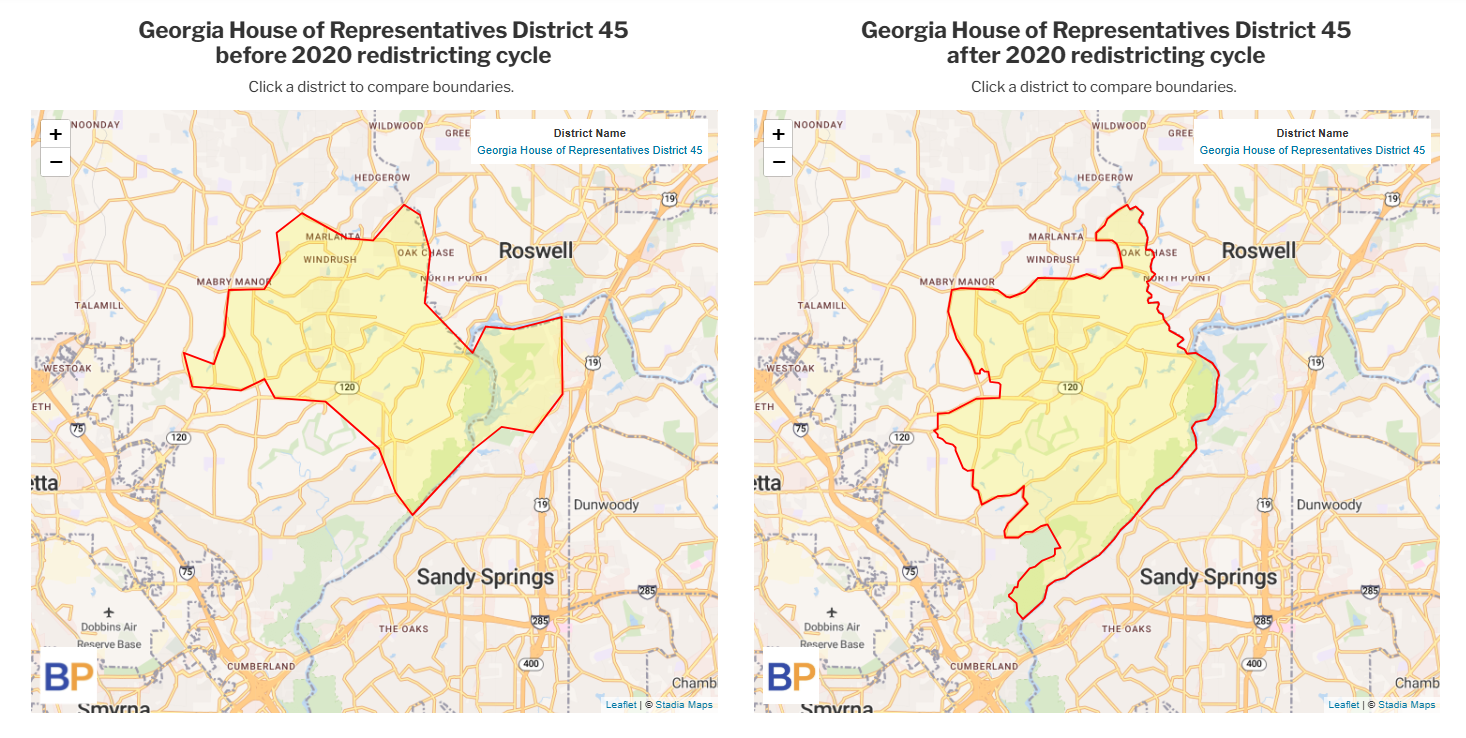
Georgia House District 45 Before and After Redistricting
Our neighborhoods stayed the same. The district boundaries did not. These maps show Georgia House District 45 before and after the 2020 Census redistricting. The updated map took effect for the 2024 election cycle. Source: Ballotpedia.
It sounds like a simple question.
Who represents East Cobb under the Gold Dome?
Most of us assume the answer stays the same unless we move to a new home or elect someone new. But over the past several years, many East Cobb residents have found themselves in a different legislative district, represented by different district numbers and, in some cases, different elected officials, despite never moving.
Our neighborhoods stayed the same, but the maps did not.
For many people, legislative maps are easy to overlook. They can seem like technical details best left to lawmakers, attorneys, and policy experts. Yet those lines shape something deeply personal: who speaks for our community, who advocates for our schools and neighborhoods, and who is accountable to the people who live here.
That’s why representation matters.
Why Do District Maps Change?
Redistricting is a normal part of our democracy. Every ten years, after the U.S. Census, states redraw legislative districts to account for population growth and ensure that each representative serves roughly the same number of people.
The goal is straightforward: As populations grow and change, district boundaries are adjusted so that representation remains as equal as possible..
But while redistricting itself is expected, the way those maps are drawn deserves thoughtful public attention.
Communities are more than collections of streets and voting precincts. They are neighborhoods, schools, businesses, faith communities, and families who share common experiences and common challenges. When district boundaries divide or reshape those communities, it can affect how effectively people are represented and whether they feel connected to those elected to serve them.
Why Are We Still Talking About Maps?
If redistricting typically happens once every 10 years, why has this issue become such a prominent topic in Georgia recently?
That's a fair question.
In recent years, Georgia's legislative maps have been revisited multiple times outside the initial post-census process. Just this summer, lawmakers considered another round of legislative redistricting, marking the third major effort affecting state legislative maps in roughly six years. Once again, communities across Georgia, including many here in East Cobb, paid close attention and made their voices heard.
Regardless of where someone falls politically, these repeated conversations remind us that district maps are not just lines on paper. They shape how communities are represented and how connected people feel to their government.
Why This Matters in East Cobb
East Cobb has experienced significant changes to its legislative boundaries in recent years. Many residents who have lived in the same home for years have watched district numbers change around them.
Most people understandably don't follow every map adopted by the General Assembly. They simply want to know who represents them and trust that their community has a meaningful voice in the decisions that affect their daily lives.
That trust is important.
Healthy representative government depends on more than elections. It depends on people believing that the communities they call home are being represented fairly and that elected officials remain accountable to the people they serve.
What Fair Representation Looks Like
Fair representation is not about guaranteeing a particular outcome or favoring one political party over another.
Instead, fair representation is about:
creating a process that earns public confidence
respecting communities whenever possible
drawing districts transparently
giving voters meaningful choices
Most importantly, it means preserving a system where representatives earn the trust of the people they serve rather than relying on the lines of a district to determine the outcome before the conversation even begins.
That principle benefits everyone, regardless of political party.
Republicans, Democrats, and Independents all deserve confidence that elections are fair, communities are respected, and public officials remain accountable to the people they represent.
A Stronger East Cobb
East Cobb is growing. Our community is welcoming new families, new businesses, and new perspectives while remaining rooted in the neighborhoods that make this such a special place to live.
As our community evolves, our system of representation should strengthen the connection between people and their government, not weaken it.
The question isn't simply who represents East Cobb today.
The deeper question is whether East Cobb has a meaningful voice in choosing who represents it tomorrow.
I believe our democracy works best when communities are respected, public trust is earned, and elected officials remain accountable to the people they serve.
That is the kind of representation East Cobb deserves.
Learn More
For those interested in exploring this issue further, here are a few resources that informed my thinking:
Georgia General Assembly Redistricting Office
Associated Press: National redistricting battle turns to statehouses and local governments
AJC: Kemp Calls for Lawmakers Back for Redistricting (June 2026)
Join the Conversation
These are the kinds of conversations I believe we need more of in Georgia: thoughtful, honest discussions about representation, accountability, and whether our government is truly working for the people.
If this resonates with you, I’d love to have you join our campaign.
