
We Can Disagree Better
A few days ago, I came across an anonymous political survey about my race for Georgia House District 45.
Reading a political poll about yourself is a strange experience.
Some of it was familiar: my background, my work, policy positions I’ve taken.
And then I met a fictional version of myself.
She had said things I never said. Her record included claims I didn’t recognize as my own. Even my years as a professor had been reimagined in ways that bore little resemblance to what I actually taught.
As a candidate, I was frustrated.
But as a cognitive psychologist, I was fascinated.
Before my career took me into public service and research leadership, I studied how people process information and emotion. As I read through the survey, I found myself thinking less about what it said about me and more about what it reveals about the way our politics increasingly communicates with all of us.
Because the stakes are bigger than one candidate or one election.
They have something to do with trust.
Emotion Gets Our Attention
You don’t need a Ph.D. in cognitive psychology to know that emotion affects how we process information.
Think about the last headline that made you angry before you even clicked on it. Or the social media post you remembered hours later because it unnerved you or made your blood boil.
Psychologists including John Cacioppo and Daniel Kahneman spent decades helping us understand something political communicators know intuitively: We don’t process every piece of information with equal weight or deliberation. Emotionally charged information can capture our attention quickly and influence the judgments that follow.
Put simply: Make us feel something strongly enough, and the feeling can arrive before the fact-check.
That doesn’t make emotion bad. We’re human. Emotion is part of how we understand what matters.
But it can also be exploited.
When Persuasion Becomes Caricature
Campaigns test messages because they want to understand what voters care about and what might persuade them.
There is nothing inherently wrong with that.
I’m a researcher. I understand the value of testing messages. If voters care deeply about healthcare, schools, property taxes, traffic, or data centers, I want to know that. If voters disagree with one of my positions, I want to understand why.
But there’s a difference between testing which argument persuades someone and testing which version of another person provokes the strongest reaction.
That is what troubled me about the survey.
It wasn’t that it contained negative messages about me. I’m running for office. My record and positions are fair game.
What concerned me was seeing words attributed to me that I did not say and claims that did not accurately represent my record.
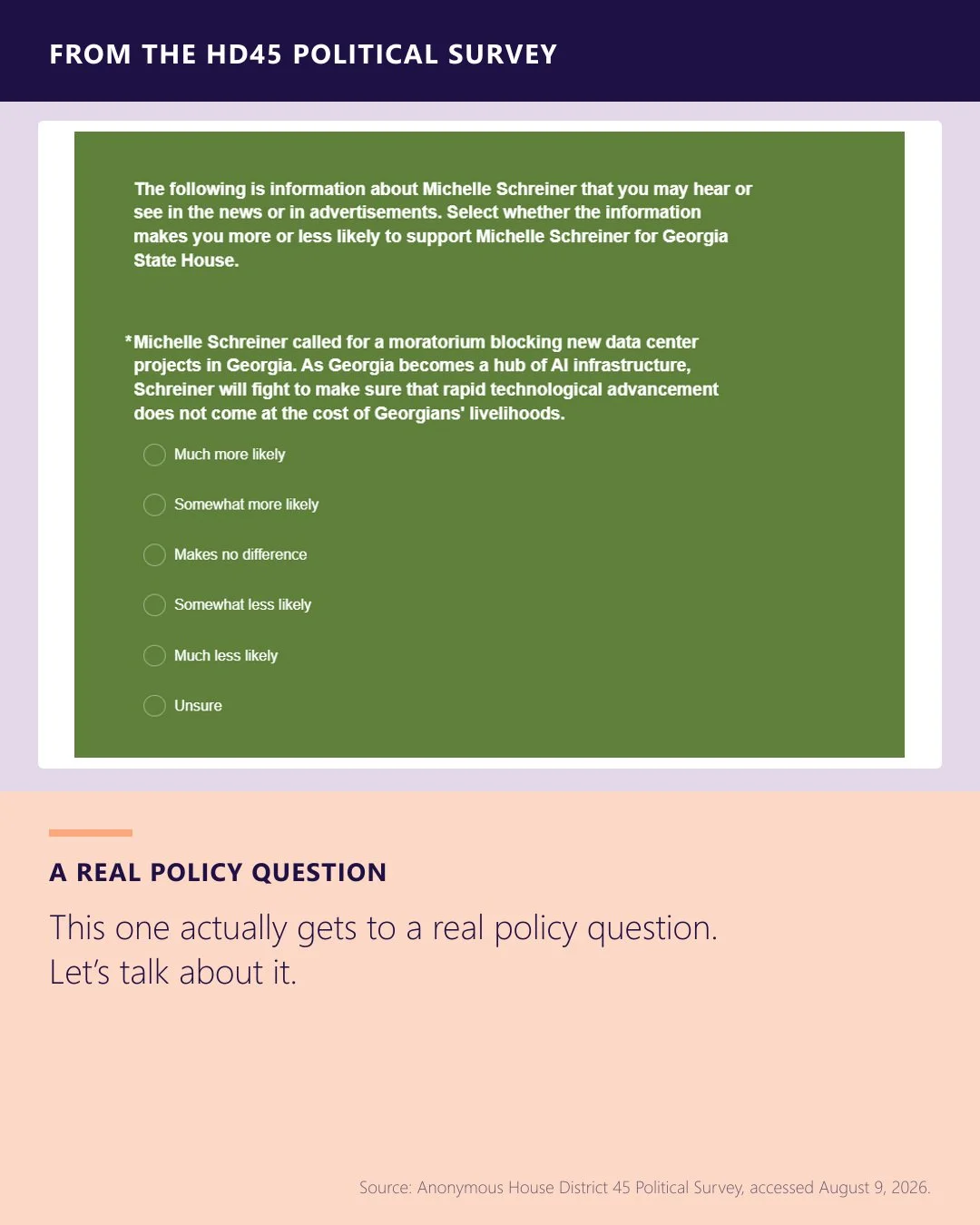
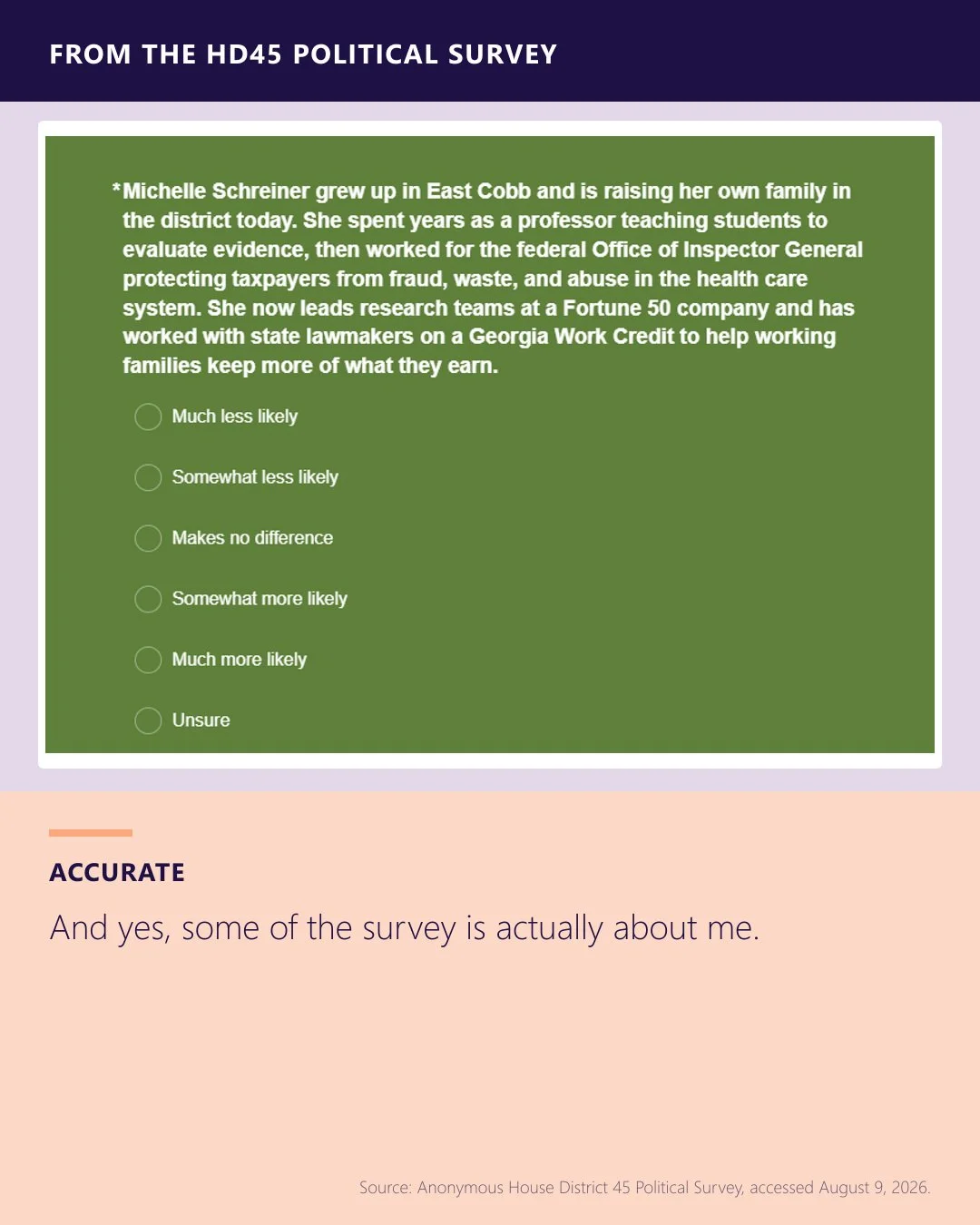
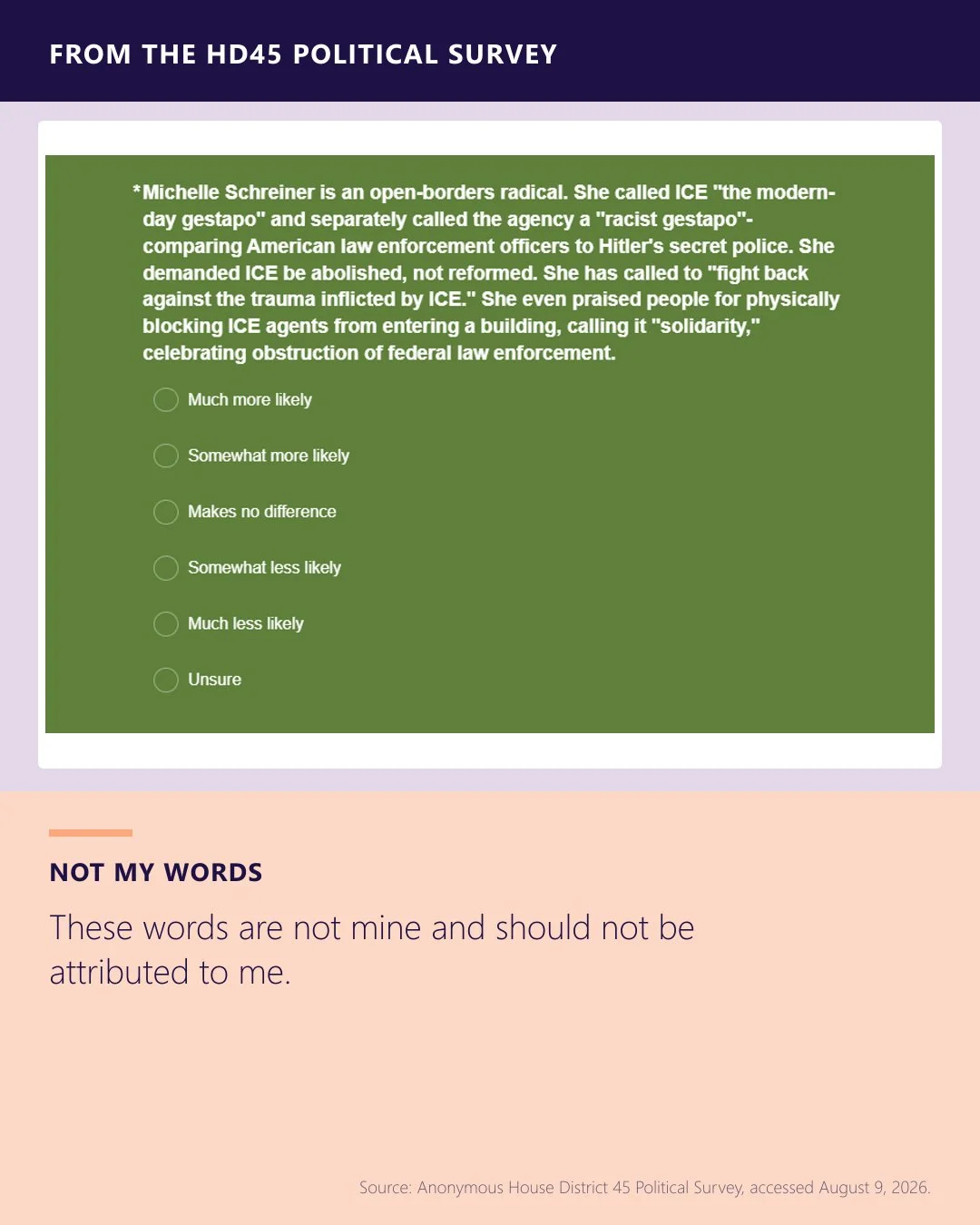
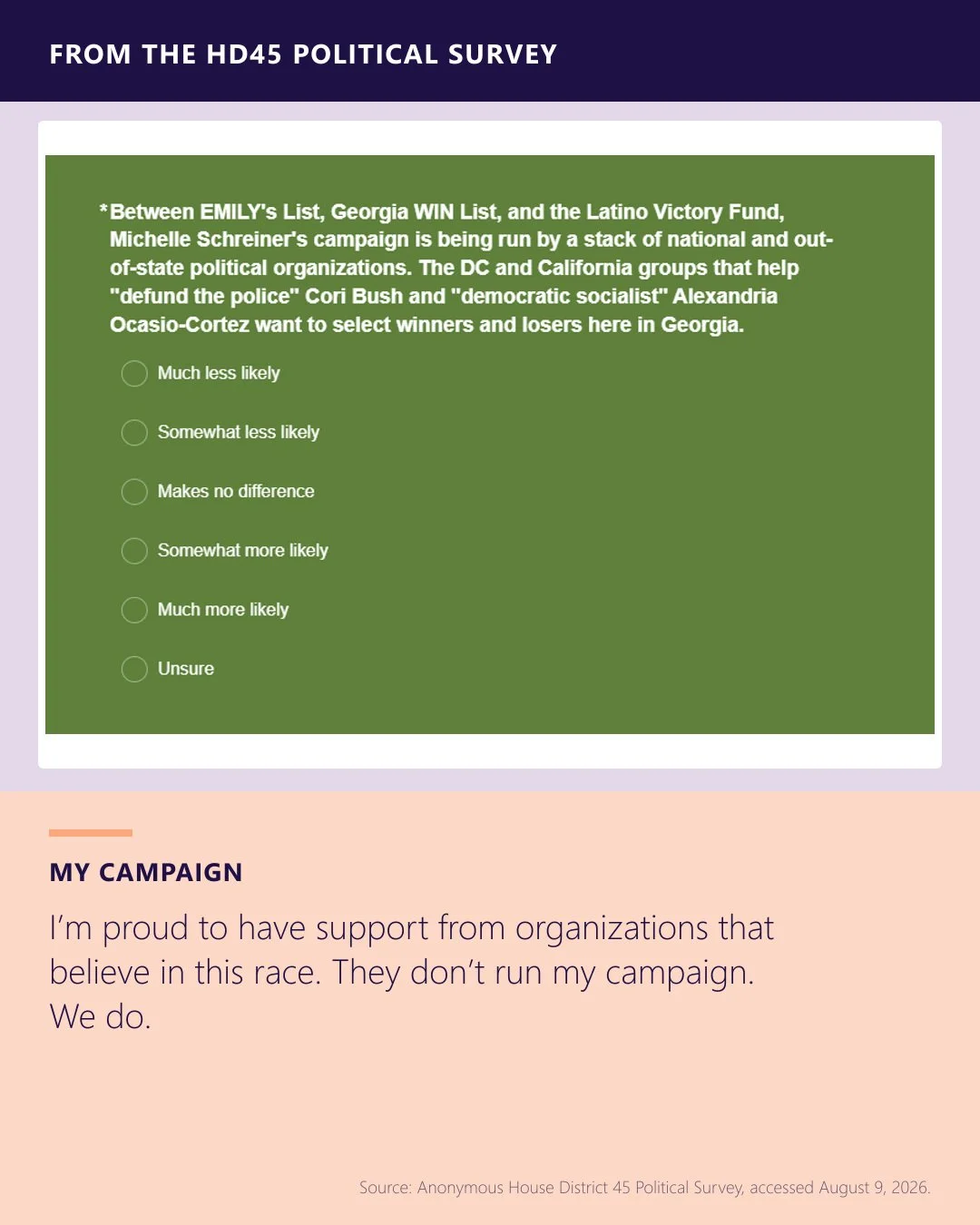
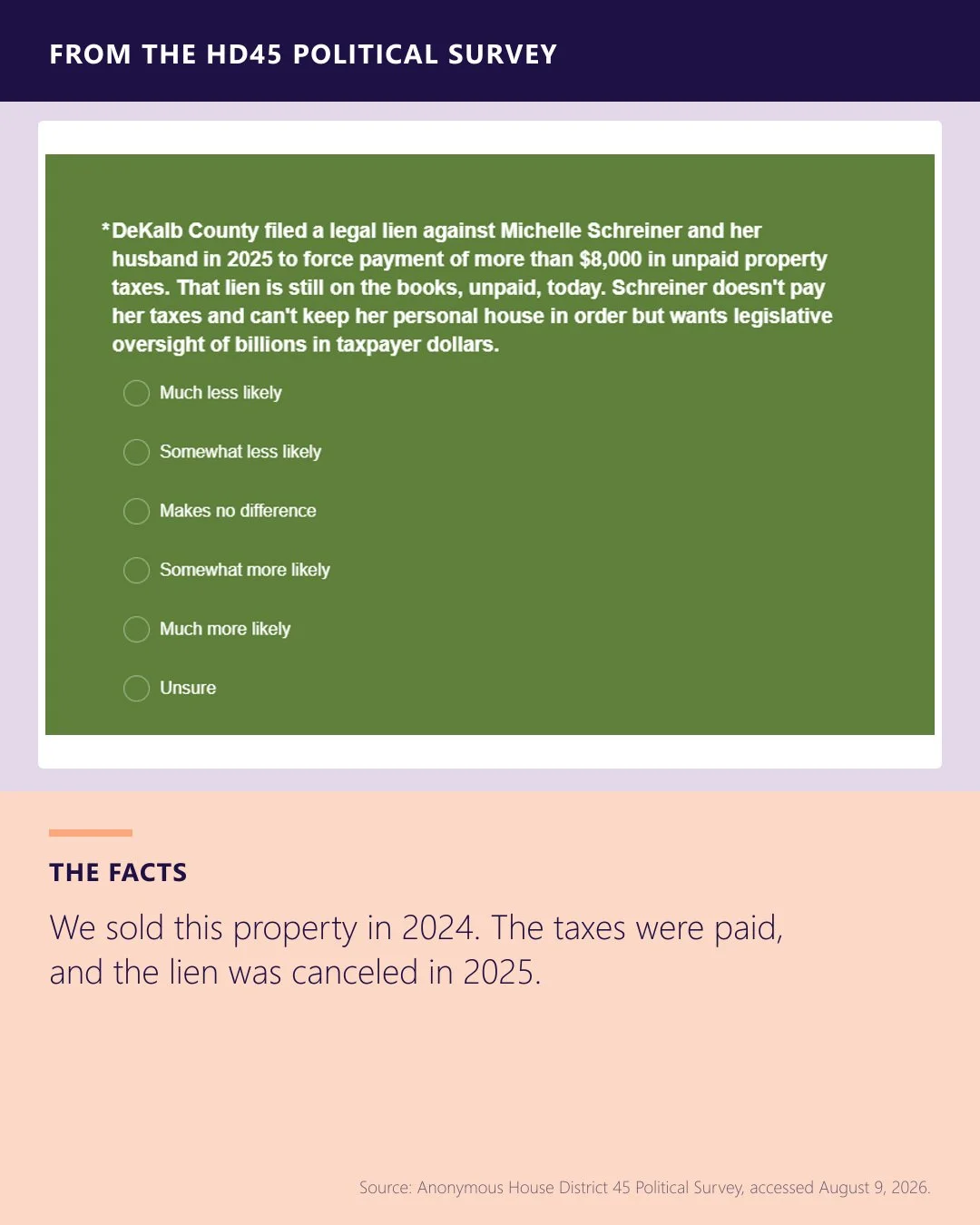
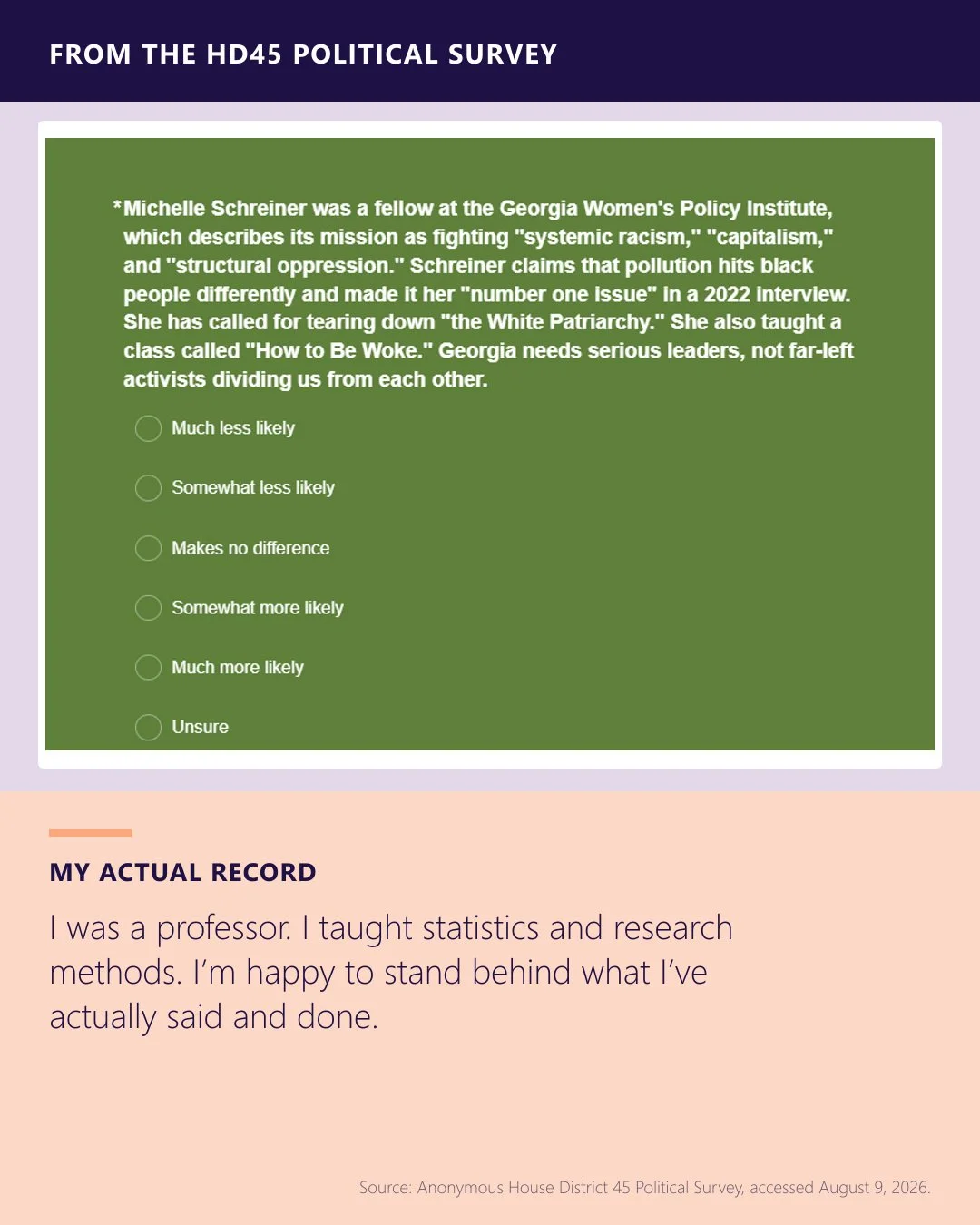
At that point, we are no longer asking voters to evaluate an actual person. We are asking them to react to a character someone has constructed for them.
And if that caricature produces a stronger emotional response than the real person would, the distortion itself can become politically useful.
It may help win an argument.
But I think it costs us something much bigger.
The Cost Is Bigger Than One Candidate
When I knock on doors and talk with voters, I hear a concern again and again: People are losing trust in our institutions.
This is not an abstract concern about a distant thing called “government.”
Institutions are ultimately made up of people.
Our legislatures are made up of legislators. Our schools are led by educators and school boards. Our courts depend on judges and public servants. Our elections rely on people. And every person who holds elected office was, at some point, a candidate asking the public for its trust.
“When we systematically demean the people who seek to serve in those institutions, we shouldn’t be surprised when trust in the institutions themselves begins to erode.”
That doesn’t mean public officials should be shielded from criticism.
Trustworthy institutions require accountability, but accountability depends on facts.
If every disagreement becomes evidence of bad character, every opponent becomes an enemy, and every election requires constructing the most frightening version of the person on the other side, eventually we stop debating actual people and actual ideas.
We start reacting to caricatures. And those caricatures don’t disappear after Election Day. They become part of how we learn to see one another.
Disagreement Is Not the Problem
I don’t want a politics without disagreement. Frankly, that sounds both impossible and kind of boring.
Democracy assumes that people with different experiences, priorities, and values will sometimes reach different conclusions.
So raising our standards doesn’t mean criticizing less.
It means criticizing better.
Challenge my ideas. Scrutinize my record. Question my judgment. Tell voters why you believe I’m wrong.
And yes, character matters in public service. Honesty, judgment, competence, conflicts of interest, and conduct are all legitimate considerations when deciding whom to trust with public power.
But hold me accountable for what I actually say and actually do.
Don’t invent a person who is easier to defeat than the one actually standing before you.
And that standard has to apply to all of us.
I can’t ask others to represent me truthfully while giving myself permission to distort the people I oppose. If we want better politics, we have to be willing to hold our own side to the same standards we expect from the other.
Sunshine Is the Best Disinfectant
That is why I decided to talk publicly about the survey rather than simply file it away as another unpleasant part of running for office.
Sunshine is the best disinfectant.
Show people the source. Correct the record when necessary. Be transparent about what you believe. Then trust people to think for themselves.
Understanding how our minds process emotional information does not make any of us immune to its effects. I spent years studying human cognition, and I am still human.
That’s why our standards matter.
We can’t expect every voter to investigate every claim or catch every distortion. But we can expect more from the people asking for their trust.
That includes me.
I will say things people disagree with. I will take positions people question. If I am fortunate enough to serve, I will make decisions that some people believe are wrong. And because I am human, I will make mistakes.
Hold me accountable for them.
And I owe that same standard to the people I disagree with.
Democracy doesn’t require us to agree. It requires us to find a way to disagree while still recognizing one another as people worthy of truth, dignity, and respect.
We can raise the standard.
Not by disagreeing less.
By disagreeing better.
Learn More
Additional sources and reporting related to the ideas discussed in this piece.
Psychology and affective processing
Kahneman, Daniel. (2013). Thinking, fast and slow (1st ed.). Farrar, Straus and Giroux.
Ito, T.A., Larsen, J.T., Smith, N.K., & Cacioppo, J.T. (1998). Negative information weighs more heavily on the brain: The negativity bias in evaluative categorizations. Journal of Personality and Social Psychology, 75(4), 887-900.
Anonymous House District 45 Political Survey
Accessed on August 9, 2026.
Marietta Daily Journal (Aug 14, 2026). Around Town: Cobb at Center of Battle for Control of Georgia House.
Download PDF copy here.
Join the Conversation
These are the kinds of conversations we need more of: Thoughtful, evidence-based discussions where disagreement is welcome and our shared humanity remains intact.
You don’t have to agree with me. I’d rather hear what you think.
