
Data Centers: Who Pays for the Tax Breaks?
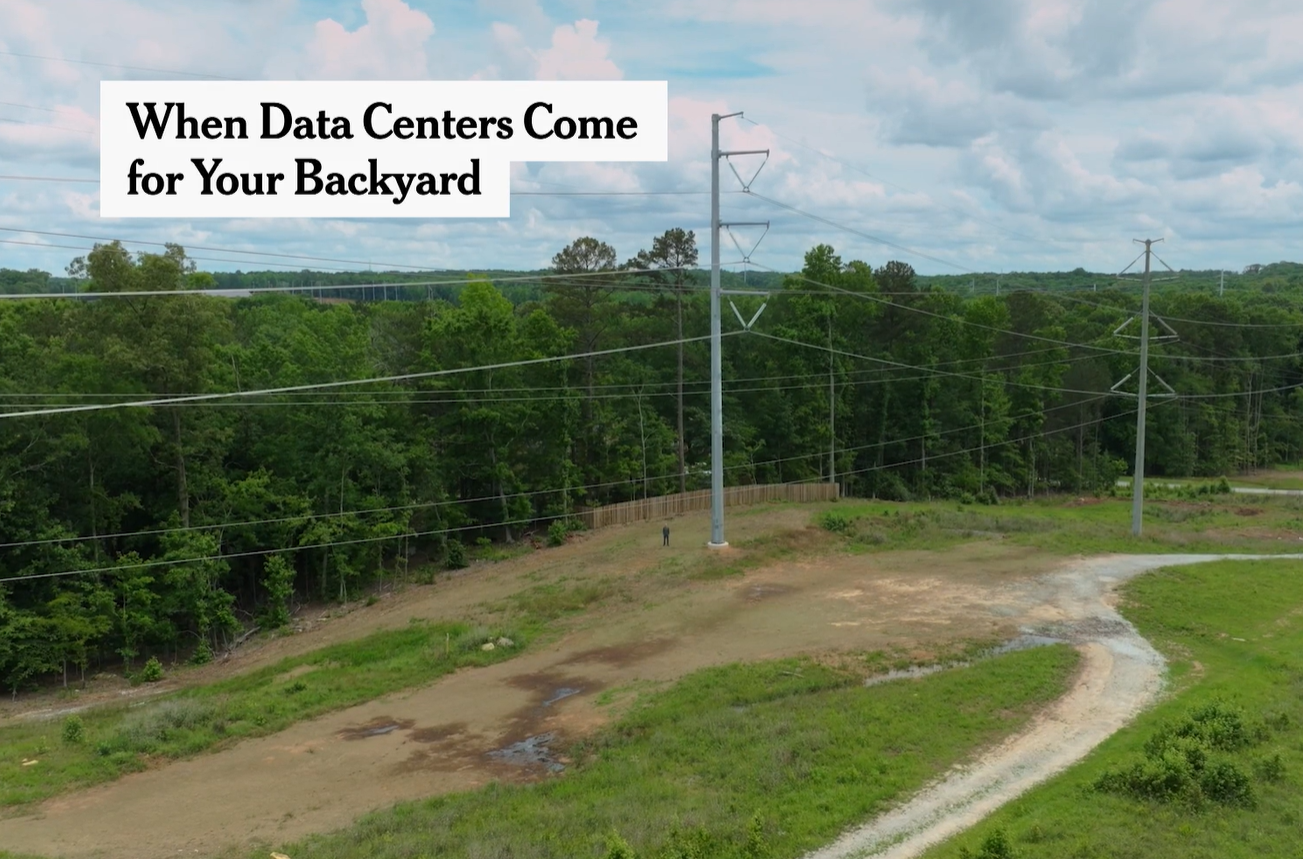
An aerial view of Doug Fergus in his backyard in Fayetteville, Georgia, where a new power line was installed to meet the increased demands of electricity.
Credit: Ang Li, Mark Boyer, Arthur Thompson and Rafaela Balster from the New York Times.
This post is Part 2 of a series exploring data centers, artificial intelligence, and Georgia's future.
In Part 1, I examined the questions Georgia should answer before approving additional large-scale data center development, including impacts on energy demand, water resources, infrastructure, and local communities.
In this post, I explore a different question:
Who is paying for this growth?
As I continued researching this issue, I found myself asking a different set of questions.
I expected to spend most of my time learning about AI infrastructure. Instead, I was surprised to discover the scale of Georgia's tax incentives for data center development.
That sent me down another path of research.
And what I found raises important questions about transparency, accountability, and how we invest public dollars.
The 2018 Tax Break
In 2018, Georgia passed HB 696, creating a sales and use tax exemption for qualifying data centers. The goal was economic development. Georgia wanted to compete for technology investment, attract new businesses, and position itself for growth in the digital economy.
That is a reasonable goal.
Technology is an important part of Georgia's future, and data centers may play an important role in supporting that growth.
But economic development should not mean blank checks, hidden costs, or subsidies that grow beyond public oversight.
Eight years later, Georgians deserve a clearer understanding of what we are investing, what we are receiving in return, and whether the arrangement is delivering the public benefits we were promised.
The Cost Is Growing
Georgia's own FY2027 Tax Expenditure Report notes that estimates were revised because of a "dramatic increase in data center construction" across the state.
What caught my attention was how dramatically the projected cost of these incentives has changed over time:
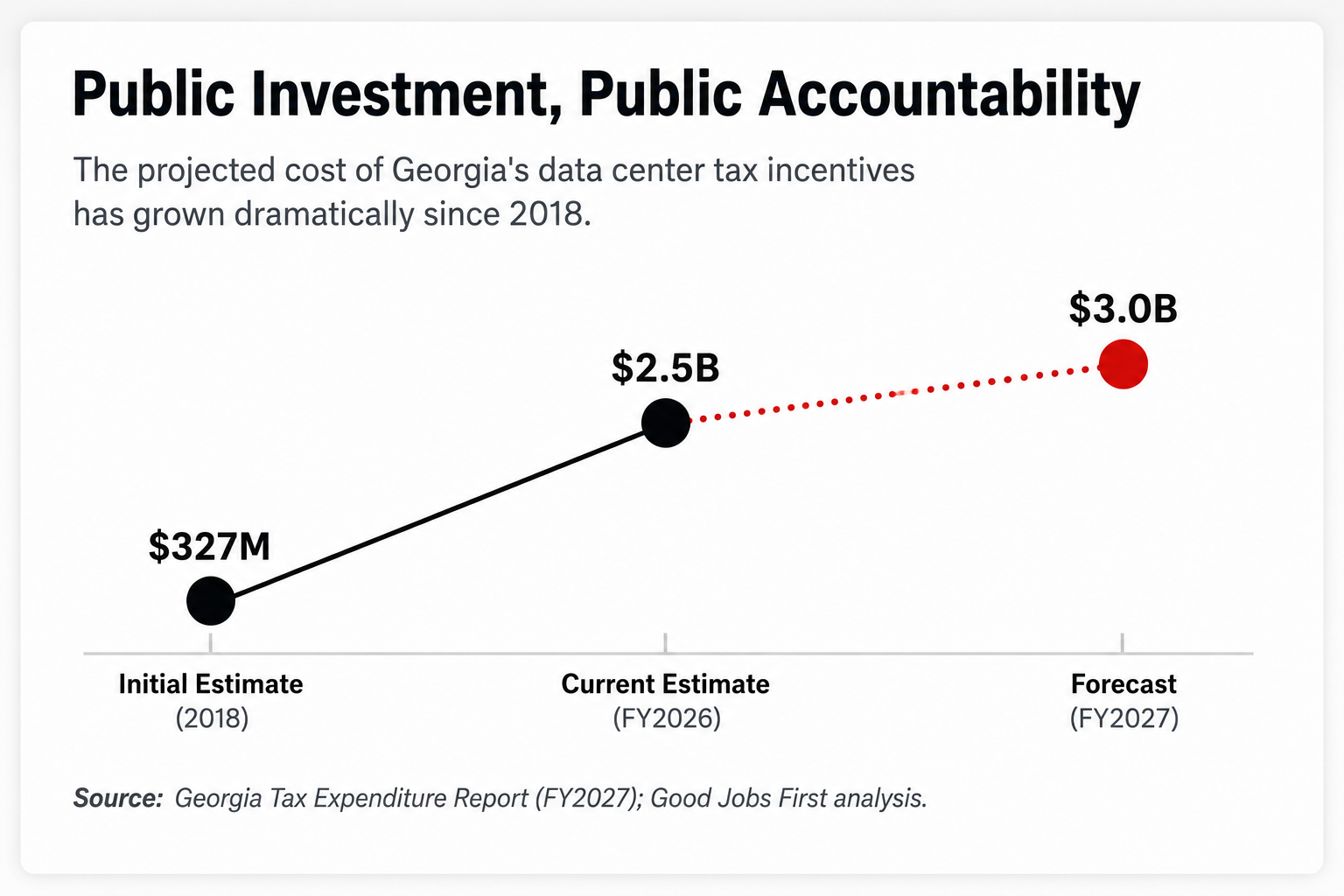
Georgia's data center tax incentives have grown dramatically since their original projections. Initial estimates were approximately $327 million. Current estimates suggest costs of approximately $2.5 billion in FY2026 and nearly $3 billion in FY2027, with cumulative projected revenue losses reaching roughly $7.3 billion between FY2025 and FY2027.
Taken together, Georgia is projected to forego approximately $7.3 billion in tax revenue between FY2025 and FY2027 through this single tax incentive.
That does not automatically mean the incentive is a bad idea. Economic development often requires investment.
But when the public commitment reaches billions of dollars, the public deserves a clear understanding of the expected return. How many jobs are being created? What infrastructure costs are being shifted to taxpayers? Are these incentives changing business decisions, or are they subsidizing projects that would have located here anyway?
Those are reasonable questions, and Georgians deserve clear answers.
Whether future estimates ultimately prove accurate or not, the trend is clear: The financial stakes are much larger than they were when these incentives were first adopted.
Why This Matters
Data center development is not inherently a public need in the same way that schools, roads, water systems, or public safety services are.
Rather, it is a response to growing demand for artificial intelligence, cloud computing, streaming services, and digital storage.
That distinction matters.
When public resources are committed to support private development, taxpayers deserve a clear understanding of the expected benefits, the associated costs, and whether the investment serves the broader public interest.
Economic development can create real opportunities. But it should also be accompanied by transparency, accountability, and a clear explanation of how communities will benefit.
These decisions have the potential to influence:
The reliability and future capacity of Georgia's electric grid
Water resources shared by communities across the state
Public and private investments in infrastructure
Economic development, jobs, and local tax revenue
Quality of life for nearby residents and neighborhoods
Georgia's ability to responsibly prepare for an AI-powered future
For people trying to build a future in Georgia, these choices matter. Public dollars help fund the systems people rely on every day, from schools and roads to water infrastructure and public safety.
Technology and Accountability Can Coexist
This is not an argument against technology.
I work in technology, and I believe AI will create extraordinary opportunities in the years ahead.
But being pro-technology does not require us to subsidize some of the largest and wealthiest companies in the world without stronger public accountability.
Tax expenditures can sound technical, but the basic idea is simple:
“When the state chooses to forego collecting revenue from one group of taxpayers, that decision affects everyone else.”
If the public benefit is clear, measurable, and meaningful, an incentive may be justified. But value should be demonstrated, not assumed.
At a minimum, Georgia should require greater transparency, public reporting, regular legislative review, infrastructure cost-sharing, and a clear accounting of costs and benefits.
We should also be asking how many permanent local jobs these projects create after construction ends, who pays for additional pressure on the electric grid, and whether these incentives remain necessary for projects that may already be likely to locate here.
Who Benefits, Who Pays?
Many Georgia families are feeling squeezed by rising costs in housing, childcare, healthcare, utility bills, and property taxes. Local governments are trying to keep up with growth while maintaining roads, schools, water systems, and public safety services.
Against that backdrop, it’s fair to ask whether Georgia's growing investment in data center tax incentives is producing benefits that justify the cost.
Tax policy is ultimately a statement of priorities.
If Georgia can commit significant public resources to attract data center development, then Georgia can also have a serious public conversation about whether those investments are serving the public interest.
The issue is not whether Georgia should participate in the future of technology.
We should.
The issue is whether we are planning for that future responsibly.
Communities deserve transparency. Taxpayers deserve accountability. And before we continue expanding data center development across Georgia, we deserve a clearer understanding of the financial deal being made on the public's behalf.
Learn More
For those interested in exploring this issue further, here are a few resources that informed my thinking:
Georgia Tax Expenditure Report for FY2027 (Georgia Office of Planning and Budget / Fiscal Research Center, Georgia State University)
HB 696 (2018), establishing the Georgia Data Center Sales and Use Tax Exemption
Good Jobs First reporting and analysis on data center subsidies and tax incentives.
New York Times (June 2026). When Data Centers Come for Your Backyard.
Continue the Conversation
This series began with a simple observation: Data centers are not just a local issue. They sit at the intersection of technology, infrastructure, energy, water, economic development, and public policy.
In Part 1, I focused on the physical impacts of data center growth and the questions communities deserve to have answered.
In Part 2, I examined the financial side of the equation and why transparency matters when billions of dollars in public resources are involved.
In Part 3, I'll explore the larger question this series has led me to ask:
How do we prepare ourselves to govern wisely in a time of rapid technological change?
Join the Conversation
These are the kinds of conversations I believe we need more of in Georgia: thoughtful, evidence-based discussions about the challenges and opportunities shaping our future.
If this resonates with you, I'd love to have you join our campaign.
